

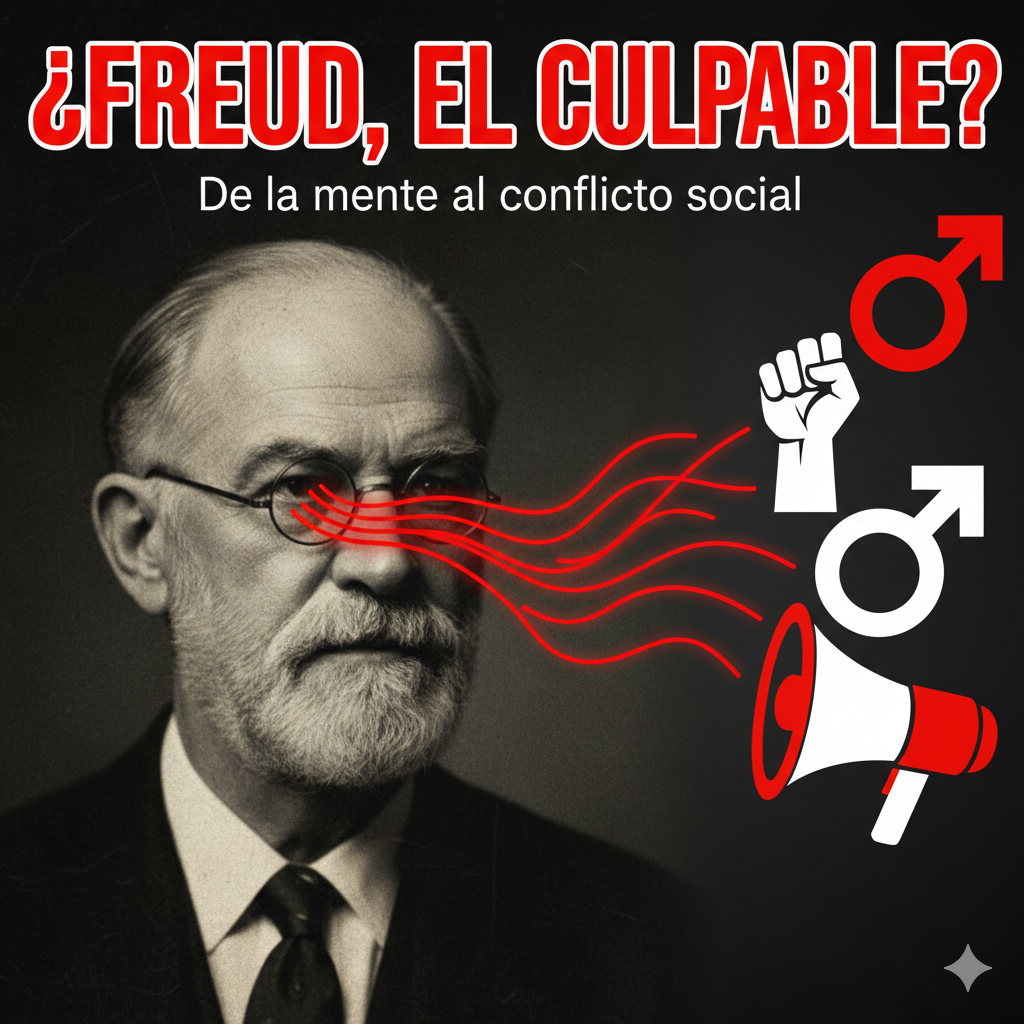
The Freudian Lie: How Psychoanalysis Created the Terrain for the Tyranny of Identity.
Freud’s Long Shadow: A Critique of the Foundations of Psychoanalysis and Its Influence on Contemporary Culture
From our perspective, one that emphasizes individual reason, personal responsibility, and the limits of coercive power, the figure of Sigmund Freud and his intellectual legacy deserve a critical examination. While his influence in the 20th century is indisputable, arguing that his theories laid philosophical foundations that later fueled contemporary ideological movements such as Critical Race Theory (CRT) and the so-called “woke culture” is not an invention, but rather an analysis of the evolution of ideas. The danger lies not in a direct conspiracy, but in the inheritance of a framework of thought that, according to Freud, undermines individual agency and replaces observable reality with subjective interpretations
Psychoanalysis: Replacing Reason with Occult Determinism
The first and fundamental problem that thought finds with Freud is his distancing himself from the rational and conscious mind. By postulating that human behavior is determined by unconscious forces, primitive impulses, and repressed childhood conflicts, psychoanalysis minimizes the role of conscious choice and individual responsibility. For me, the individual is an autonomous agent whose decisions, the fruit of reason and will, are the foundation of a free society. Freud, on the other hand, presents a model where the conscious “ego” is a fragile raft at the mercy of an ocean of uncontrollable drives (the “id”) and internalized social mandates (the “superego”). This psychological determinism creates a paradigm where the person is not fully in control of their actions, a conceptual precursor that paves the way for views where individuals are seen primarily as products of external forces.
The Method of Interpretation: The Seed of Radical Subjectivism Psychoanalytic methodology is equally problematic.
By relying on the symbolic interpretation of dreams, slips of the tongue, and free associations, Freud constructed a system that is inherently unfalsifiable. If a patient rejects the analyst’s interpretation, this resistance can, in turn, be interpreted as confirmation of the repressed complex. This hermeneutic cycle, where theory is self-validated regardless of empirical evidence, sets a dangerous epistemological precedent. It prioritizes an internal, subjective “truth,” accessible only to the initiated expert, over objective reality and verifiable evidence. This is a crucial point: the turn to subjective interpretation as the arbiter of truth is a cornerstone of later ideologies that argue that subjective lived experience (e.g., based on race or gender) takes precedence over objective facts or universal principles such as equality before the law.
The Philosophical Link: From Freud to Critical Theory The connection is not direct, but it is historically and intellectually traceable.
The thinkers of the Frankfurt School (Max Horkheimer, Theodor Adorno, Herbert Marcuse), known as the fathers of Critical Theory, explicitly integrated elements of Freudian psychoanalysis into their revision of Marxism. They brought class conflict into the cultural and psychological realm. Just as Freud viewed individual neurosis as the result of repressed drives, Critical Theory argued that “repressive” Western society created social pathologies. Marcuse, in particular, in “Eros and Civilization,” argued that capitalist society required “repressive desublimation” to liberate instincts. This approach applied a psychoanalytic framework to collective social criticism. If for Freud, individual distress was the fault of familial repression, for critical theorists, the distress of entire groups was the fault of oppressive social structures (the collective “superego”). The individual as a rational agent disappears, replaced by a subject determined by his group membership and victimized by invisible but omnipresent systems of power.
The Contemporary Connection:
From the Unconscious to Group Identity This is the most dangerous legacy critics point to: the transition from psychological determinism (Freud) to sociological determinism (Critical Race Theory, intersectionality). CRT, for example, argues that racism is not primarily an act of conscious individual prejudice, but is invisibly embedded in legal and cultural institutions, operating as a collective “racial unconscious.” Like the Freudian analyst who reveals the patient’s hidden conflicts, the critical theorist “unveils” the structural racism invisible to the untrained eye. “Woke culture,” at its most dogmatic, replicates the psychoanalytic model of interpretation. Disagreement with its tenets is not considered legitimate intellectual disagreement, but rather a “denial” or “resistance” that tests the depth of one’s internalized conditioning (the equivalent of the “resistance” of Freud’s patient). This closes the debate and gives unquestionable authority to the ideological interpretation.
Reaffirming the Individual From our perspective, Freud’s legacy, filtered through Critical Theory, is profoundly civic. It shifts blame and responsibility from the individual sphere to abstract forces (the unconscious systems of power), eroding the notion that people are masters of their destinies. It replaces rational, evidence-based discourse with a language of subjective interpretation and accusations of unconscious bias, making constructive dialogue impossible. The true antidote to this perspective is not to deny the existence of prejudices or psychological conflicts, but to reaffirm the Enlightenment principles that Freud helped undermine: the primacy of individual reason, freedom of conscience, personal responsibility, and an unwavering commitment to objective evidence and the rule of law as guarantors of a society of free individuals. Freud’s danger was not a failed psychological theory, but the door he opened to a view of the human being as a puppet of hidden forces, an idea that, when applied to politics, is profoundly damaging to freedom.
About the Author