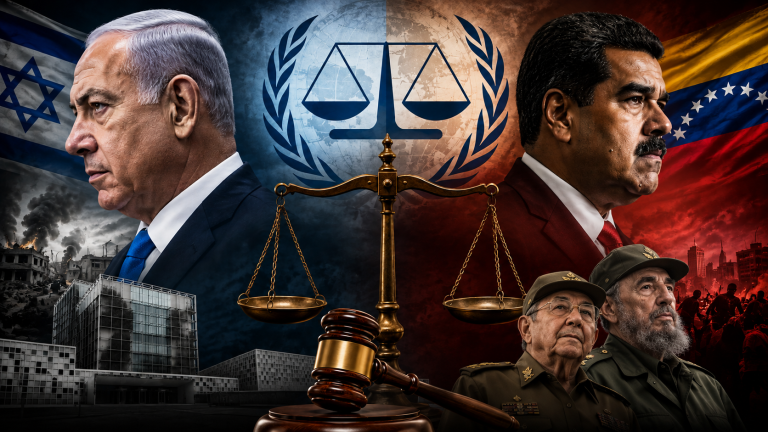

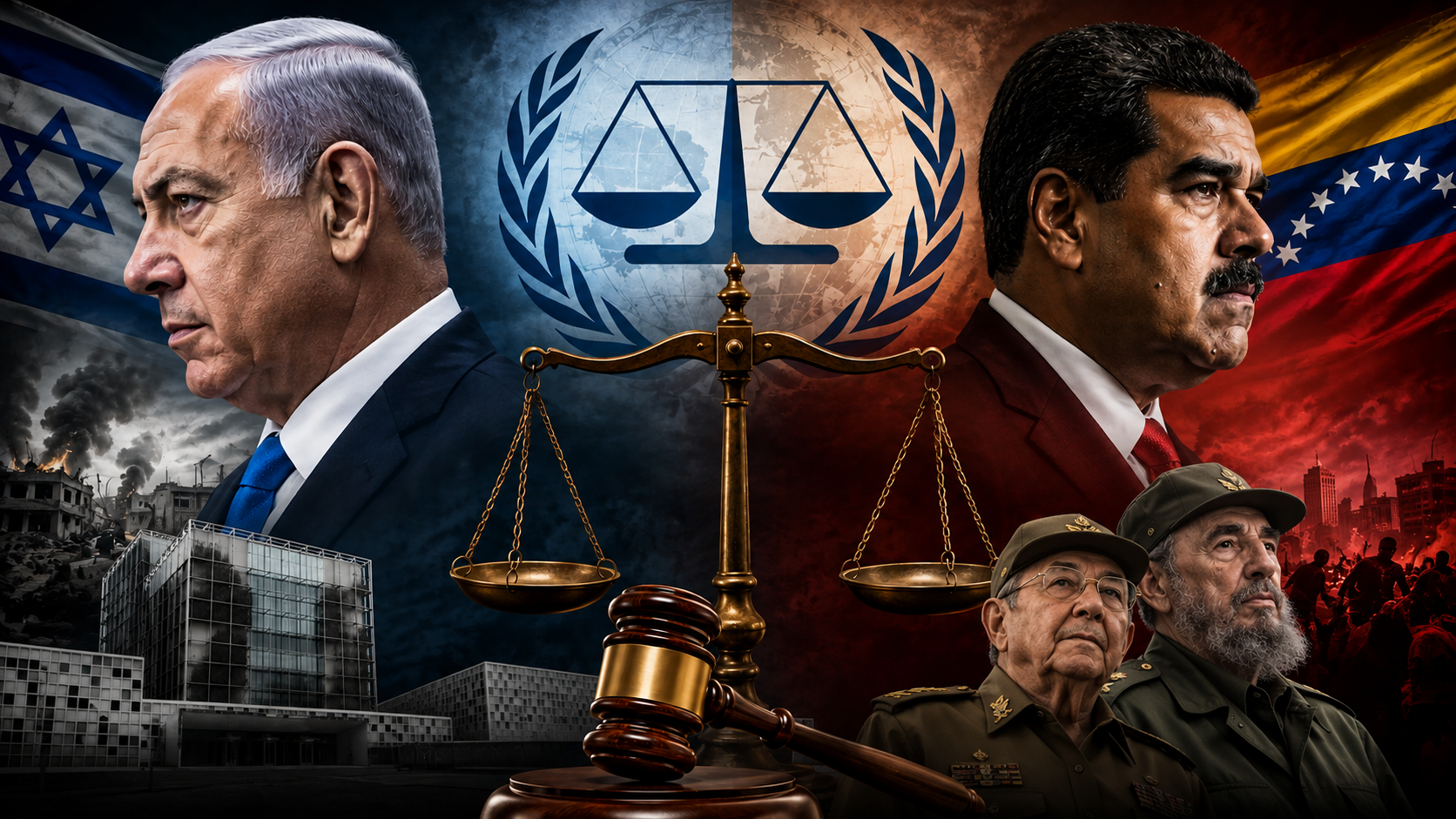
The ICC under scrutiny: Why is the case against Netanyahu moving forward while Maduro keeps waiting?
A Court that can act with speed when it wants to, but that can also take years to produce results when it does not want to.
International justice has a problem that goes far beyond Benjamin Netanyahu, Nicolás Maduro or any other head of state.
The problem is trust.
When an institution created to prosecute the world’s most serious crimes acts, the citizen expects its criteria to be consistent, its procedures to be transparent, and the weight of justice not to depend on who is sitting in the dock.
And there appears an uncomfortable question: why do some international files seem to advance with extraordinary speed while others remain for years in preliminary stages, shelved and in evident lethargy?
The comparison between Israel and Venezuela allows that question to be raised.
But to do so correctly one must separate facts from opinions.
Netanyahu: an arrest warrant is not a real conviction, but it leaves in the eyes of the public a moral condemnation.
On May 20, 2024, the then Prosecutor of the International Criminal Court, Karim Khan, requested arrest warrants against Benjamin Netanyahu and Yoav Gallant.
Only 6 months later, on November 21, 2024, the Pre-Trial Chamber issued the warrants.
The ICC itself explained that it found “reasonable grounds” to believe that Netanyahu and Gallant could be criminally responsible for certain war crimes and crimes against humanity related to the situation in Gaza. In exactly the same way, the majority of people see reasonable grounds, to use the redundancy, to consider that the judge incurs in the crime of prevarication for what we will set out below.
But here there is a fundamental legal difference that cannot be ignored:
Benjamin Netanyahu was not convicted by the International Criminal Court.
There was no trial, there was no guilty verdict and there is no final conviction against him.
There is an arrest warrant.
The ICC’s own official file continues to identify him as a person “at large”, that is, not in the custody of the Court, which implies that it is not an arrest warrant. Then that legal form is used to make it clear, very confusingly, that an arrest warrant has been released only for public impression but not for those involved. True madness.
This does not eliminate the debate about the Court’s decision. It makes it legally more precise in the eyes of the Court but politically disastrous in the eyes of the public.
The question is not whether Netanyahu was convicted.
The question is why the Prosecutor’s Office considered that there were sufficient grounds to request an arrest warrant in a relatively short period of time and why other files, open for many more years, have not reached that stage.
Venezuela: an investigation that began much earlier
The comparison with Nicolás Maduro is especially striking.
The ICC Prosecutor’s Office opened a preliminary examination on Venezuela in February 2018, four years after the crimes had been committed and presented before the Court for evaluation. In September 2018, several member States referred the situation to the Court to investigate alleged crimes against humanity committed since February 2014. It is worth clarifying that none of those states has declared itself socialist. Argentina, Canada, Chile, Colombia, Paraguay, Peru, Costa Rica and Uruguay.
On November 3, 2021, 7 years later, Prosecutor Karim Khan formally announced the opening of an investigation.
That is, we are not talking about a recent file.
We are talking about an investigation that had been going on for more than 7 years.
And here an important precision appears: Although the cases number more than 2,800, there is not that quantity of individual cases against Nicolás Maduro at the ICC, at least not in the Court’s public records.
What exists is the so-called Venezuela I Situation, an investigation into alleged crimes against humanity where the accused is Venezuela and not Nicolás Maduro himself.
What is verifiable is that the Venezuelan investigation has gone on for years without producing an arrest warrant against Maduro and any member of his circle.
The ICC did not forget Venezuela
It would also be incorrect to claim that the Court simply “forgot” the Venezuelan file.
In 2022, the Government of Venezuela requested that the investigation be deferred to the national authorities.
The ICC Prosecutor’s Office requested authorization to resume it, which indicates that it was indeed shelved, and in June 2023, that is 9 years later, the Pre-Trial Chamber authorized the resumption of the investigation.
Ten years later, in March 2024, the Appeals Chamber confirmed that decision.
Therefore, the problem is not that the case disappeared, because the Court had it; the problem that can legitimately be raised is another:
Why has an investigation initiated in 2018 but known to the Court since 2014 still not produced an arrest warrant against the main political leader pointed out in the public debate about those facts even today, 12 years later?
That is a much harder question to answer.
The episode that changed the discussion: Karim Khan and his sister-in-law
And here appears one of the most delicate elements of this entire story.
Venkateswari Alagendra, a lawyer who represented Venezuela before the ICC, is the sister of Karim Khan’s wife; that is, she is his sister-in-law.
The family relationship was documented within the Court’s own proceedings.
Initially, an external request to recuse Khan was declared inadmissible by the Appeals Chamber in February 2025, which for the first time casts doubt on the impartiality of the Court, among other reasons because the person who presented it lacked procedural standing to formulate it in those terms, as we all know these legalistic tricks are applied every day in Third World courts. The Chamber recalled, however, that the prosecutor has the duty to act impartially and to request his own recusal when he considers that a ground for disqualification exists, and international pressure began.
Subsequently something much more significant occurred.
On August 1, 2025, the Appeals Chamber determined that there were reasons to consider that a ground for disqualification of the prosecutor in relation to Venezuela I could exist. The question was linked precisely to the circumstances surrounding his relationship with the lawyer who represented Venezuela and the pressure from countries that normally abide by the law.
Finally, on September 2, 2025, the ad hoc Presidency of the ICC accepted Karim Khan’s request to step aside from the Venezuela I situation. Which makes the Court’s credibility even poorer, since its intention was to leave him in that post for reasons that not even Karim Khan could understand at that moment.
This does not mean that the ICC has declared that Khan deliberately favored Maduro, but it is the impression of at least 80% of Venezuelans and a large number of lawyers and decent people.
Nor does it mean that the Court has determined that corruption existed, since it is the same Court that is allegedly committing the crimes of prevarication that kept him in the post despite his refusal to allegedly consummate a crime of bribery or another form of prevarication.
But it does mean something institutionally important:
the question of his impartiality reached the point of producing his removal from the Venezuelan file.
And that deserves to be known and discussed.
Is there an equivalent in the Netanyahu file?
No equivalent family relationship publicly appears between the prosecutor and members of Netanyahu’s legal team.
Therefore the comparison must be made carefully; only those politically connected to the Court have that right.
In Venezuela there existed a family and professional circumstance around the prosecutor that ended up provoking his recusal.
In the Netanyahu file, the controversies have revolved mainly around questions such as the Court’s jurisdiction, the legal situation of Palestine, territorial competence and the challenges presented by Israel.
The ICC itself reported that on November 21, 2024 it rejected Israel’s objections to jurisdiction and issued the arrest warrants with an impressive celerity whose speed makes the courts of Che Guevara in La Cabaña pale by comparison.
They are not identical situations.
Precisely for that reason the comparison is interesting.
The true anomaly of the ICC: years of investigation and very few convictions
The history of the International Criminal Court also allows one to understand why there is so much frustration around it.
The ICC began to function in 2002.
Since then it has opened investigations in numerous countries and has issued dozens of arrest warrants, but the number of convictions is considerably smaller and if we analyze more carefully, politics is the protagonist of the majority of cases.
Data compiled in 2025 counted 11 convictions and four acquittals, with approximately 60 arrest warrants issued. Of those 11 convictions, only six corresponded to the principal crimes over which the Court has competence: war crimes and crimes against humanity, where the Court turns a blind eye when it comes to Christians in Africa or proceedings against Islamic extremists.
That reveals an uncomfortable reality:
The arrest warrant does not equate to guilt and the investigation does not equate to conviction, but it does leave a very negative halo over the people it judges.
An international criminal process can take years.
The problem, then, is not simply that the ICC is slow.
The problem is to determine whether that slowness is applied in a consistent manner.
The other problem is that it is very susceptible to being used as a weapon to remove opponents from the path as this case allegedly appears to be.
And Fidel Castro?
Fidel Castro constitutes another example that usually appears in these discussions, but here it is also necessary to separate the political accusation from the legal jurisdiction, to use the redundancy again.
There is no International Criminal Court case against Fidel Castro.
The fundamental reason is temporal.
The Rome Statute entered into force on July 1, 2002 and the Court does not possess general jurisdiction over acts committed before that date.
In addition, Cuba was never a State Party to the Rome Statute.
Therefore, although during Fidel Castro’s government there existed numerous international denunciations related to human rights violations, those denunciations could not automatically become a case before the ICC. Very conveniently.
The Court also did not receive a referral from the United Nations Security Council that would have created a jurisdictional path for Cuba. Nor does that seem strange to me.
Therefore, to say that “the ICC let Fidel Castro die without judging him” is politically understandable as criticism, but legally imprecise, yet naturally true.
The Court simply did not have general competence to judge the greater part of the acts attributed to the Cuban regime during the decades prior to 2002. Which makes him the luckiest man on the planet because he finds himself precisely between the Nuremberg trials and the ICC. The same as his little brother.
And Raúl Castro?
The situation of Raúl Castro also cannot be presented as an ICC file that has been abandoned.
There is no public ICC case against Raúl Castro comparable to Venezuela I, since they are very different; Raúl Castro has the same record as Fidel but the same policies as the International Criminal Court.
This does not mean that international denunciations about the Cuban regime do not exist.
It means that a denunciation, a political accusation, a human rights investigation and a case before the International Criminal Court are four different things.
Confusing them can produce impactful headlines, but it also allows the critics of an investigation to dismantle the entire argument through a legal error, which as we said before the legalistic tricksters have nooks and crannies through which to escape and more so when the courts have their same political courts.
It would not surprise me if the forms allegedly are instructions from the same Court.
The true problem: equality before justice or selective justice?
Here is where the discussion becomes truly political.
The ICC maintains that its function is to investigate and prosecute the most serious crimes when national jurisdictions cannot or will not do so.
That principle is powerful.
But it also creates an equally powerful obligation:
the perception of impartiality.
If an investigation takes years, the public wants to know why.
If another produces an arrest warrant relatively quickly, the public wants to know why.
If a prosecutor has a family relationship with someone linked to one of the parties and ends up removed from the file, the public has the right to ask what internal controls allowed that situation to exist.
And if the institutional answer is that each file is different, then the Court has to explain clearly what those differences are.
It is not enough to ask for trust.
International institutions have to produce reasons that allow it to be justified.
Netanyahu, Maduro and the danger of confusing a warrant with a sentence
The Netanyahu case also demonstrates another problem.
Political rhetoric usually converts an arrest warrant into a conviction.
But legally they are not the same.
The ICC accuses.
The judges determine whether there are grounds to continue.
Subsequently a trial may be held.
And only after a judicial process can there be a conviction.
The ICC’s own history demonstrates that not all accused persons end up being convicted. Laurent Gbagbo and Charles Blé Goudé, for example, were acquitted of the charges of crimes against humanity and those acquittals were subsequently confirmed on appeal.
Therefore the serious discussion should not be whether Netanyahu is “guilty” because the ICC issued a warrant.
The discussion must be whether the standards used to investigate, request warrants and eventually prosecute different leaders are consistent.
The question of the United States
This discussion inevitably leads to Washington.
The United States is not a State Party to the Rome Statute and has maintained for decades a conflictive relationship with the ICC.
In 2025, Donald Trump imposed sanctions related to the Court and to ICC officials, in the context of the American opposition to certain actions of the tribunal.
The American criticism of the ICC is not new.
But one thing is to question jurisdiction or even to withdraw from certain international structures and another very different thing is to affirm that the organization can simply be expelled from New York. For me perhaps not for legal questions but yes for moral ones.
The headquarters of the United Nations is located in New York by means of an agreement between the United States and the United Nations signed in 1947. That agreement establishes the legal regime of the headquarters and contains specific mechanisms to resolve disputes, and perfect, let them be followed, but the nations that participate all have to pay to participate; it cannot be a very onerous burden for American taxpayers and the rest of the planet to act as if the United States are the bad guys of the planet when everyone who participates in that forum has at some time had their life saved by them, even Russia and China themselves.
Nor does there exist a mechanism by which the United States can unilaterally “expel the UN” as if it were a private organization installed in a building, but it can withdraw the resources.
The United Nations Charter establishes, in addition, a specific procedure to expel a member State: recommendation of the Security Council and decision of the General Assembly.
Therefore, if one wants to defend politically a reduction of American participation in international organizations, that argument can be raised.
But it must be distinguished from a supposed immediate legal faculty to evict the United Nations from New York, and yes, but if the United Nations insists, all the procedures will have to be carried out to leave that organization legally.
We all know that it is an anachronistic organization with very negative tendencies that develop policies that never should have been executed such as the endemic ones.
The question that remains on the table
The central question is not whether the ICC should prosecute Netanyahu.
Nor whether it should prosecute Maduro.
If sufficient evidence and jurisdiction exist, both should be subjected to the same legal standard as any other person.
The problem is precisely that: the same standard.
An institution of international justice cannot allow the world to have the impression that its procedures depend on the country, the leader or the political convenience of the moment.
Venezuela has been under investigation for years.
Palestine produced a much more visible and rapid action against Netanyahu where the majority of the evidence is allegedly created.
In Venezuela, in addition, the prosecutor himself ended up removed from the investigation after the Court’s instances examined the circumstances related to his family and professional link with a lawyer who represented Venezuela—note carefully, not Maduro.
But said that way it would seem that it was the Court that removed Karim Khan from his post for this simple anomaly, when it was Karim Khan who asked the Court to leave the post so as not to incur an evident illegality that would mark his career.
Netanyahu, for his part, has an arrest warrant, but not a conviction, which makes him guilty very conveniently in the eyes of the public.
Maduro has an open investigation, but no public arrest warrant, for more than 12 years.
Fidel Castro never had a file before a Court that, during a good part of his government, did not even exist and moreover did not mesh with the policies of the ICC.
And Raúl Castro also does not currently face a public equivalent case before the ICC for the same reasons as Fidel.
The facts are considerably more complex than the slogans.
But precisely for that reason the question is legitimate:
Is international justice applying a universal standard or are we facing a system whose results end up depending too much on international politics?
As long as the ICC does not manage to answer that question convincingly, its enemies will continue speaking of double standards and its defenders will have to explain why cases of apparently comparable gravity produce such different procedural results.
International justice cannot demand blind trust.
It has to earn it.
About the Author