
The Hidden Institutional Risk Behind the Tariff Ruling
I read with concern the recent Supreme Court decision on tariffs because, beyond the specific case, the institutional impact is profound. This is not about whether tariffs are good or bad in economic terms; what is at stake is who has the authority to decide them and within what limits.
The United States Constitution, in Article I, Section 8, grants Congress the power to regulate foreign commerce and impose tariffs. However, Congress itself, aware of its structural slowness and the time constraints imposed by the legislative process, has delegated part of that authority to the Executive Branch through laws such as the Trade Expansion Act of 1962 (Section 232) and the Trade Act of 1974 (Section 301). This delegation is neither accidental nor improvised; it responds to the practical need to react quickly to trade crises, national security threats, or unfair practices by other countries.
Congress, by design, is a broad deliberative body, with complex procedures, committees, debates, and qualified majorities. That slowness can be virtuous in preventing hasty decisions, but it is less effective when the global economy demands immediate responses. For that reason, lawmakers chose to transfer specific tools to the Executive Branch to act with speed. That political decision has already been made by the constitutionally competent authority.
When the Court intervenes to substantially restrict or reinterpret that delegation, it is not merely reviewing formal legality; it is altering the balance that Congress itself established. And that is where the problem arises. If the Legislative Branch decided that the Executive should have broad discretion in tariff policy for reasons of efficiency and timeliness, the judicial function should be limited to verifying that the Executive acts within the legal framework, not redesigning the institutional scheme.
There are precedents that illustrate this tension. In American Institute for International Steel v. United States (2019), companies challenged steel tariffs imposed under Section 232 during the administration of Donald Trump. The courts upheld the constitutionality of the broad delegation to the Executive, and the Supreme Court declined to review the case. At that time, the prevailing view was that Congress had legitimately delegated that authority and that the Executive was acting within its framework.
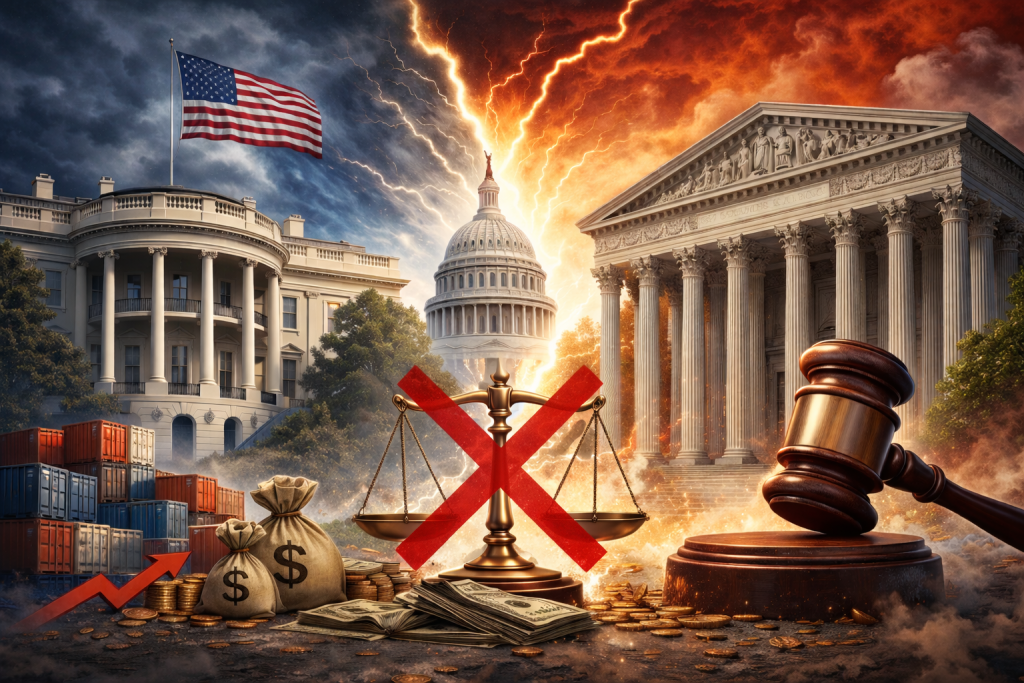
Economic history offers clear lessons about the need for responsiveness. The Smoot-Hawley Tariff Act of 1930, signed by Herbert Hoover, resulted from a prolonged and highly politicized legislative process. Its effects contributed to worsening the global trade crisis during the Great Depression. Precisely to avoid such rigidity, Congress in later decades chose to delegate trade authority to the Executive.
From my point of view, if the Court now excessively reduces or conditions that delegation, it does more than limit the Executive; it introduces a precedent that could enable a dangerous dynamic. If the Judiciary redefines delegated economic powers, the Executive may be tempted to expand its interpretation in other areas. And the Legislature, feeling displaced, might attempt to reclaim authority in a rushed or politicized manner. The result would not be greater balance, but constant friction among branches.
Moreover, the institutional signal is delicate. Economic policy, especially in international trade, requires coherence and speed. Trade partners observe not only decisions but the stability of the institutional framework. If every executive measure becomes subject to broad judicial reinterpretation regarding its political scope or convenience, the country’s negotiating capacity weakens.

Separation of powers does not mean each branch invades the functional space of the other, but that each respects the constitutional design. Here, the Legislature chose to delegate; the Executive acts under that delegation; the Judiciary must ensure legality, not substitute the political-economic judgment already assigned by law.
When a court enters into the substantive definition of economic policies that Congress chose to place in the hands of the Executive, the balance shifts. And if that precedent consolidates, it could open the door to cross-branch interference that erodes institutional clarity.
The debate over tariffs may change with economic circumstances, but the principle must remain firm: each branch within its proper sphere. Constitutional stability and economic prosperity depend, to a large extent, on keeping that line from becoming blurred
By RM
About the Author