
When the Earth Shook, Socialism Had Already Destroyed the Country
When the Earth Shakes and the State Is Already Broken: Socialism and Venezuela’s Vulnerability to a National Catastrophe When a major earthquake strikes, attention tends to focus on the power of nature.
Images show collapsed buildings, destroyed roads, overwhelmed hospitals, and thousands of people seeking help. Yet, there is a far more important question that is rarely asked: was the country prepared to face a tragedy of this magnitude?
The answer determines how many lives can be saved, how quickly rescuers arrive, how long it takes for hospitals to respond, and how many years a nation will need to rebuild.
A country poorer than before receiving the greatest oil boom in its history.
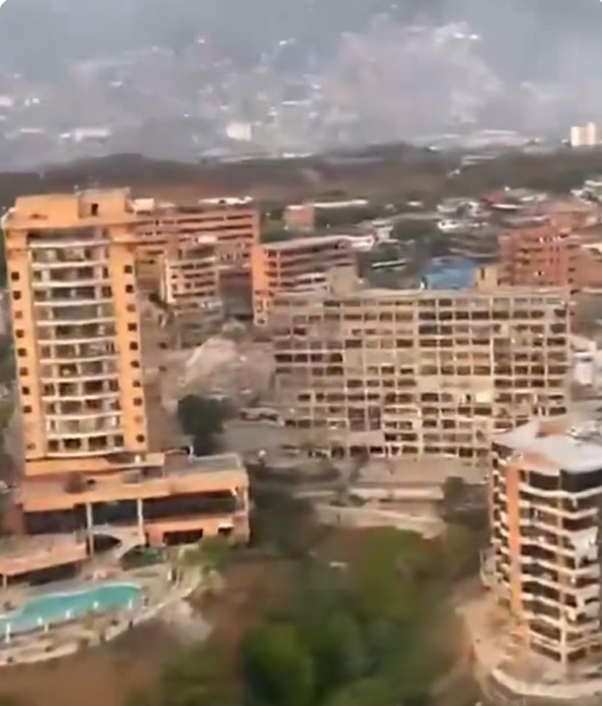
Between 1999 and 2014, Venezuela received extraordinary oil revenues estimated by various studies at over one trillion dollars. Few nations in the world have enjoyed such a massive influx of resources in such a short period.
Sin embargo, lejos de traducirse en una economía más fuerte y diversificada, Venezuela terminó convirtiéndose en uno de los mayores colapsos económicos registrados en tiempos de paz.
However, far from translating into a stronger and more diversified economy, Venezuela ended up experiencing one of the greatest economic collapses recorded in peacetime.
To grasp the magnitude of the disaster, one need only recall that few wartime economies have experienced such deep declines.
When an economy loses three-quarters of its size, it also loses the capacity to fund hospitals, roads, electrical systems, rescue services, universities, and public services.
And that has direct consequences when a national emergency occurs.
The disappearance of Venezuelan industry
One of the most compelling pieces of data comes from industrial records.
At the beginning of the Chavista era, there were approximately:
13,000 operational industries.
Two decades later, around… remained:
2,500 to 2,600 industries.
This means that approximately the following disappeared:
10,400 industries.
In percentage terms:
More than 80% of Venezuela’s industrial base has ceased to exist.
In other words:
For every ten industries operating when the socialist Bolivarian Revolution began, eight disappeared..
The hardest-hit region was precisely the Valencia-Carabobo industrial axis, historically considered the country’s manufacturing heart.
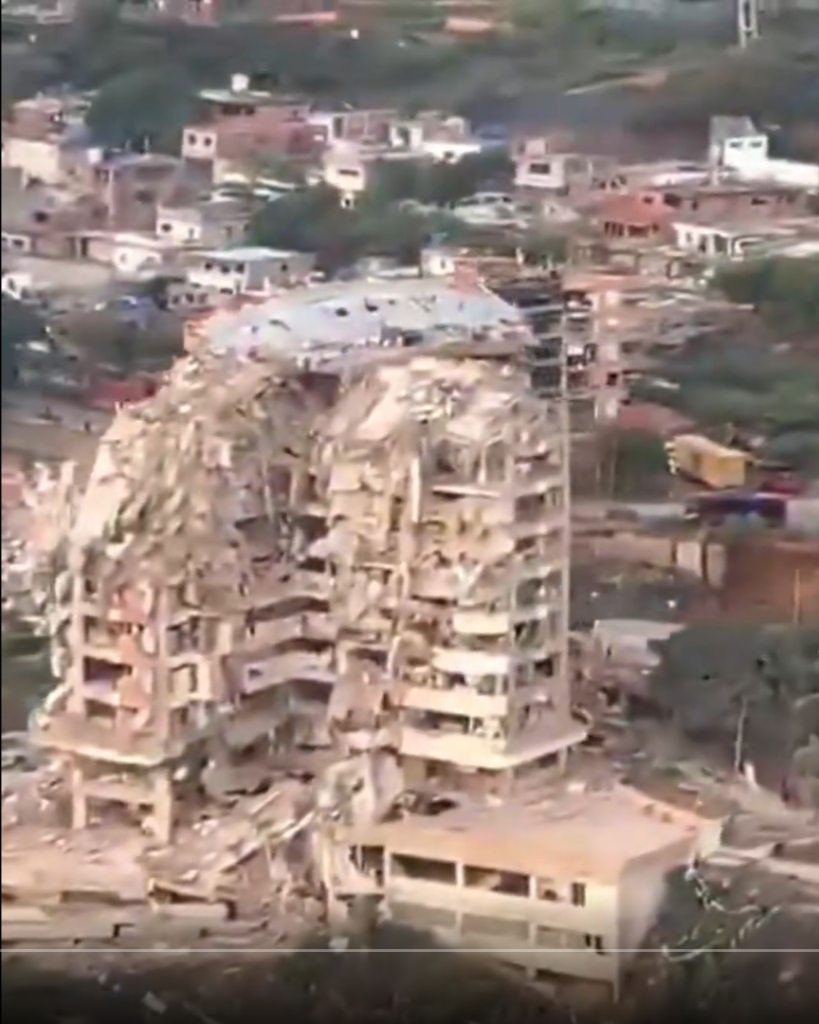
Entire sectors were devastated:
- Automotive.
- Metalworking.
- Cement.
- Steel.
- Chemicals.
- Plastics.
- Agro-industry.
- Food manufacturing.
Many of the companies that survived operate today at a fraction of their original capacity.
Why does this matter during an earthquake?
Because after a catastrophe, enormous quantities of the following are needed:
- Cement.
- Steel.
- Belaying pins.
- Electrical equipment.
- Piping.
- Construction materials.
- Heavy vehicles.
An industrialized country can produce a large part of those materials.
A country that destroyed 80% of its industrial capacity must import them.
And when a country depends on imports to rebuild, every day of delay costs lives and prolongs the population’s suffering.
The Destruction of PDVSA
For decades, the oil industry was the main economic engine of Venezuela.
In the late 1990s, Venezuela produced approximately:
3.4 million barrels per day.
At various points during the crisis, production fell even below:
400,000 barrels per day.
Although negligible partial recoveries were subsequently recorded, production remains far below pre-Chavismo levels.
The consequence is evident:
Lower production means lower revenue.
Lower revenues mean fewer resources to respond to emergencies.
A massive debt
Another key element is debt.
At the end of the 20th century, Venezuelan debt hovered around:
35 billion dollars. Figures that were highly exaggerated for the time.
For years, analysts estimated that the country’s total obligations ranged between:
150 billion and 170 billion US dollars.
However, new estimates released in 2026 raise the figure to approximately:
240 billion dollars.
This represents an increase of approximately:
205 billion dollars.
Or, put another way:
The debt increased approximately sevenfold.
It is difficult to find another case in Latin America where a nation has received historic oil revenues while simultaneously accumulating such a level of debt.
The collapse of wages
Proponents of the socialist model often highlight nominal increases in the minimum wage.
But the important figure is not how many bolivars appear in a decree.
The important figure is how much a worker can buy.
In the years leading up to the economic collapse, those of Venezuelans were among the highest in Latin America.
Subsequently, the hyperinflation created by socialism destroyed purchasing power.
At various times over the last few years:
- The minimum wage fell below 5 dollars a month.
- Even for less than 1 dollar a month.
- Many public sector workers survived on total monthly incomes of between $20 and $50, including bonuses.
The cumulative loss of purchasing power far exceeds 80% and, during certain periods, approached 95%.
The exodus of millions of Venezuelans
No single piece of data better reflects the failure of a socialist economic model than the flight of its population.
Various international organizations estimate that:
More than 7 million Venezuelans left the country.
Some estimates place the figure at nearly:
9 million people of working age.
This amounts to more than a quarter of the Venezuelan population.
But it wasn’t just workers who left.
Others who emigrated:
- Doctors.
- Nurses.
- Engineers.
- Architects.
- Technicians.
- Electricians.
- Infrastructure specialists.
Precisely the professionals most needed during a national emergency.
The hospital problem.
When a large-scale catastrophe occurs, the hospital system becomes the first line of defense.
But for years, medical associations and independent organizations have denounced:
- Shortage of inputs.
- Equipment out of service.
- Electrical problems.
- Drinking water shortages.
- Staff shortage.
A country can withstand an earthquake.
What is far more difficult is enduring an earthquake when hospitals were already facing problems before the emergency began.
The human cost of institutional weakness
The difference between a strong nation and a weakened nation is not measured solely in money.
It is measured in response time.
It is measured in terms of logistics capacity.
It is measured in terms of machinery availability.
It is measured by the number of operational hospitals.
It is measured by the availability of engineers, doctors, and technicians ready to act.
And all those indicators show a profound deterioration over the last twenty-seven years.
The real lesson
Earthquakes are not inevitable.
Natural catastrophes have existed since long before any political system.
What does depend on human decisions is the capacity to respond.
From this perspective, the problem is not solely the seismic movement.
The problem is that Venezuela faces any national emergency after having lost more than 80% of its industrial base at the hands of the socialists, seen the emigration of over seven million skilled citizens driven out by socialism, suffered an economic contraction exceeding 75% due to socialism, accumulated a debt of nearly $240 billion incurred by the socialists, and experienced one of the greatest collapses in purchasing power recorded in modern history—all caused by socialist policies.
That is why, for many Venezuelans, the discussion no longer revolves solely around the earthquake.
The discussion revolves around a deeper question:
How much better prepared would Venezuela be to face a tragedy of this magnitude if, over the last few decades, it had strengthened its economy—through a system of capitalism, or even “cutthroat” capitalism—as well as its industry, institutions, and infrastructure, instead of destroying them under a socialist system that has demonstrated its perverse failure wherever it has been implemented?
About the Author