
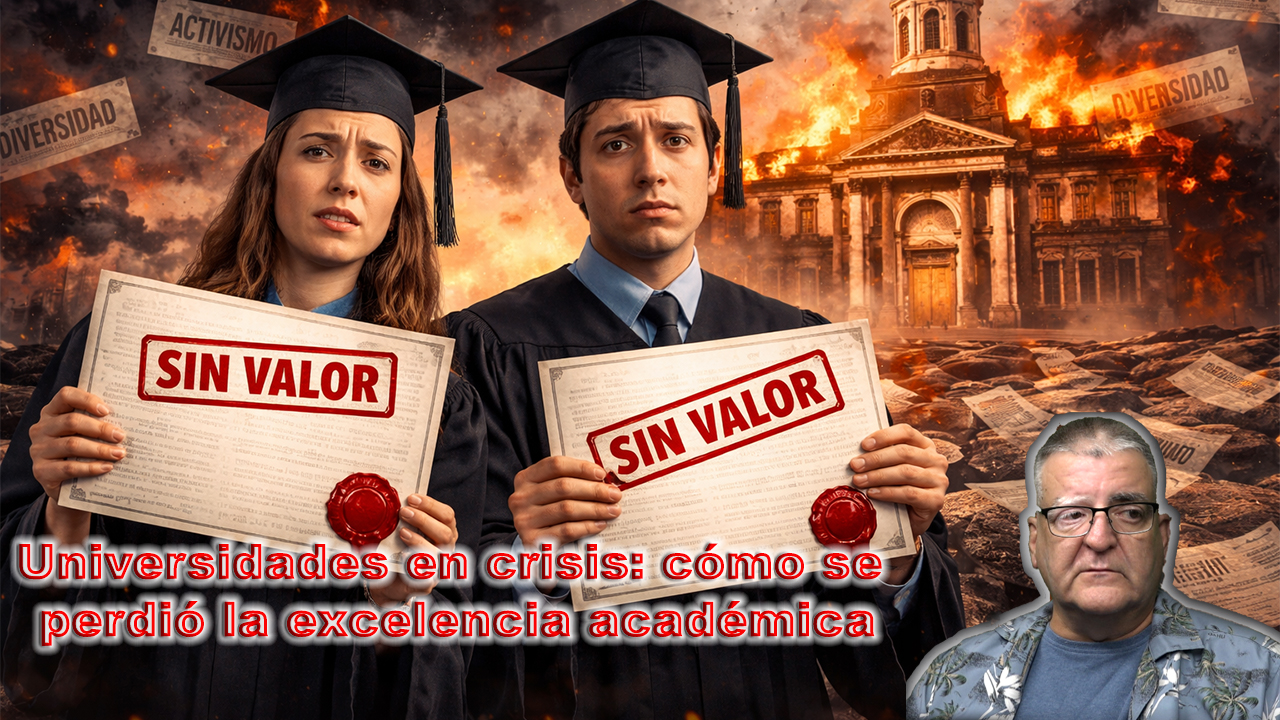
From Centers of Knowledge to Ideological Factories: The Fall of Modern Education
For decades, universities were seen as places of knowledge, where critical thinking, strong research, and academic merit guided progress. But in recent years, many people believe something has changed. What was once academic excellence is now, in many cases, being replaced by ideological agendas, growing bureaucracy, and a worrying decline in intellectual rigor.

Today, students pay record-high tuition expecting a high-quality education. Instead, many find environments where open debate is limited, ideas are filtered, and academic merit is no longer always the main standard. This shift does not seem accidental, but rather the result of years of institutional decisions.
The Erosion of Merit
One of the most visible changes is in admissions and hiring. In the past, universities focused mainly on academic performance, skills, and measurable achievements. Today, these factors often compete with — or are sometimes replaced by — identity-based criteria.
At the same time, the reduced use of standardized tests has removed an important tool for measuring ability in a clear and objective way. This raises a key question: how can universities maintain strong standards without clear benchmarks?

In addition, more flexible grading systems have created environments where expectations are lower. Some critics call this a “participation trophy culture,” where competition is reduced to avoid discomfort, but students may be less prepared for a competitive global job market.
The Rise of Administration
Another major factor is the rapid growth of university bureaucracy. In many institutions, the number of administrative staff has increased faster than the number of professors and researchers.
Departments focused on policy, compliance, and diversity programs have expanded significantly. While these goals may have value, their growth has also increased costs, leading to higher tuition.
At the same time, administrative offices now have more influence over academic decisions, course content, and campus policies. For some critics, this has shifted the focus away from knowledge and research toward institutional image and control.
The Echo Chamber Effect
Universities were once places where ideas were challenged openly. The Socratic method — based on questioning and debate — helped develop critical thinking. Today, however, there are concerns about growing ideological uniformity.
On many campuses, certain opinions are quickly labeled as harmful or unacceptable. This can lead students and professors to self-censor, fearing social or professional consequences.
As a result, universities risk becoming “echo chambers,” where the same ideas are repeated without real challenge. This weakens one of the core purposes of higher education: learning how to think, not what to think.
The Devaluation of the Degree
The effects of these changes are now visible outside universities. Many employers report a growing gap between what graduates know and what jobs actually require.
Because of this, companies are turning to alternative solutions, such as internal training programs, technical certifications, and skills-based hiring instead of relying only on degrees.
This raises an uncomfortable question: is a university degree losing its value? For some, the answer is yes — especially when education focuses more on ideology than on practical or technical skills.
At the same time, many talented individuals are leaving traditional universities and choosing alternative learning platforms that offer more direct and useful training.
The Future of Higher Education
New alternatives are already emerging. Independent academies, tech-focused training centers, and online platforms are offering more practical and efficient education.
Artificial intelligence is also changing how people learn, allowing for personalized education that can go beyond the limits of traditional systems. This could lead to a major transformation in higher education.
Still, the future is not fully decided. Universities can reform, return to academic excellence, and find a balance between inclusion and merit.
The challenge is clear: prioritize knowledge, intellectual freedom, and strong academic standards again. If they fail to do so, they risk losing their importance in a fast-changing world.
In the end, higher education stands at a crossroads. It can continue on its current path, with all its tensions, or it can reinvent itself and recover its role as a driver of progress. What is at stake is not just the future of universities, but the future of an entire generation.
By RM
About the Author